
Emma E. Murray’s stories and poems have appeared in anthologies like What One Wouldn’t Do, Obsolescence, and Ooze: Little Bursts of Body Horror, as well as magazines such as Pyre and If There’s Anyone Left. To read more, you can visit her website EmmaEMurray.com or follow her on Twitter @EMurrayAuthor
Did I Ever Know You? (never did, never will)
You died when I was (stupid/terrible/obnoxious) fifteen
and I cried many (confused/selfish/shocked) tears.
I post about it on social media every year
Garnering support, gathering sympathies in my arms and wallowing in self-pity,
but is it for you at all?
Did I know you?
Sometimes the sky cracks open, yolk-yellow, and bleeds on my kitchen table
and something in me aches like an old broken bone for a woman I never knew.
Sure, I talk about pieces of you:
X-Files and Star Trek with kitten me pressed in your doe arms,
Hair smelling like White Shoulders perfume and
fuzzy sweaters embroidered for every holiday.
Longing to be someone else, you slipped on different cultures and obsessed
over great-great-great grandmothers
in a homeland you never knew,
Birdwatching for a streak of cobalt blue,
Decorating for every holiday
and spending too much money on baubles
and tiny cards with
“Love you forever” curled inside, your handwriting branding my heart in loops and hearts.
Your embarrassing laugh, not unlike a donkey’s bray, is a precious treasure, a core memory
of you
for me.
But that’s not you.
You were a person that I never knew.
Not an archetypal mother, rosy bosom and lullaby lilt.
I only caught the faintest
glimpse of the woman you were.
Often lonely,
Locked in rooms with a glass of white wine,
You’d ask me to comb your hair
because it reminded you of your own mother.
but I’d complain.
Shut you out.
I didn’t know.
You were gone before I blinked.
I’ve heard about your wild youth, but I can’t combine the mother I knew and the girl in
those stories.
I watched you wash your hands until they bled like
raw meat in sink.
(shaking)
I closed my eyes.
(terrified)
I joked to friends that you vacuumed under our feet and fluffed pillows we rested on
but they didn’t laugh and neither did I.
You were an enigma of pain that I didn’t want to understand.
Did I ever know you?
I’m sure you’d say “yes,” but that was only the woman you wanted me to see.
I want to know you so well that I could crawl inside
your skin and soak in your desolate writhing, suppressed moans of pain
in the middle of the night
when you remember the dreams you gave up, fizzy in your fingers,
forever slipping through.
I want more than fuzzy-warm memories,
I crave the good and bad of you
to mold you into a real person
and more than just a fleeting collage of petit fours and shopping trips and chocolate buckeyes
(anxiety/depression/compulsions/resentment)
and that one searing memory, eclipsing all others
of lying next to you on a hospital bed
green-yellow under fluorescent lights while you’re
encased in a web of tubes and wires
promising my life to you if you just
stay.
“Please, stay, Mommy.”
But you left.
Tell me more than whispers behind doors about your abortion, affair, drug problem.
I’m nobody special, and neither were you.
I’ll never know you.
But I think you’d like that I think of you when the morning creeps over the horizon
And remember the smell of chocolate dust, coffee grinds, and smile at the
vague texture of you.
From the Editor:
We hope that readers receive In Parentheses as a medium through which the evolution of human thought can be appreciated, nurtured and precipitated. It will present a dynamo of artistic expression, journalism, informal analysis of our daily world, entertainment of ideas considered lofty and criticism of today’s popular culture. The featured content does not follow any specific ideology except for that of intellectual expansion of the masses.
Founded in late 2011, In Parentheses prides itself upon analysis of the current condition of intelligence in the minds of these young people, and building a hypothesis for one looming question: what comes after Post-Modernism?
The idea for this magazine stems from a simple conversation regarding the aforementioned question, which drew out the need to identify our generation’s place in literary history.
To view the types of work we typically publish, preview or purchase our past issues.
Please join our community on Facebook, Twitter, or Instagram at @inparenth.
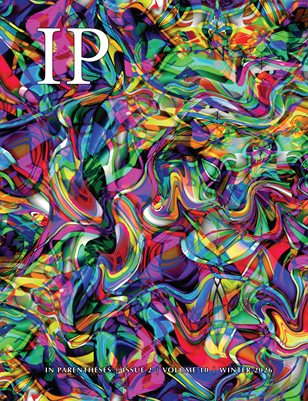
By In Parentheses in Volume 10
44 pages, published 1/15/2026

 in parentheses
enter the discussion: