
Eugene Datta’s recent poetry and fiction have appeared (or are due out) in The Dalhousie Review, Main Street Rag, Red Noise Collective, Rise Up Review, The Bombay Literary Magazine, and elsewhere. Born and raised in India, he lives in Aachen, Germany, where he works as an editor of scientific writing.
Works by E. Datta have been previously featured by In Parentheses.
Water and Wave
Although there’s no daylight between you and I,
like water and wave – the two being one, indivisible –
although, nested in you, I am what makes you what
you are, if it was possible for us to have a one-to-one,
I’d say, first of all, Yes, I do know more than you do,
(whatever you are independent of me) but less than
you may assume. I know that you’ve never wondered
what it may be like for me to be inside this airless,
lightless cavity, trying, for your sake and mine, to make
sense of the world outside, based on what the senses
tell me. It’s never occurred to you how difficult that
task is: to make you go about your everyday life
and help you survive, I make guesses all the time
(constantly correcting the ones that are wrong) about
what it’s really like out there. The room you woke up
in yesterday morning wasn’t your own, though you
didn’t know that for a moment, thanks to an error
on my part, like the dog standing on the edge
of the field was, in fact, a lost sheep, the man lurking
in the street corner the shadow of a tree, the blue
actually a green, or a shade of gray. Remember that
evening not too long ago when you almost stepped
on a snake while walking through the park and leapt
over it just in time? It was a twisted branch of a dead
tree! you’ll say. It was, but it could very well have
been a snake too, which was why I’d made you leap
over it…just in case! Just as I make you either stop
in your tracks or run if I sense trouble in the air,
as I had that morning so many decades ago – what
was it? an improvised explosive, a homemade hand
grenade that had landed with a thud close to you
as you stepped out of the house on your way
to school? No telling what would’ve happened
if it had gone off, as it was meant to, but you’d run
in the right direction, not knowing why, and the racing
heart had logged another page in our record. Without
you knowing, I make you do things all the time –
fleeting, ineffable acts that may lack the drama
of that lucky escape from harm but ensure our being
nevertheless. There’s an un-told number of things
I’ve been doing relentlessly since the first moment
of our time in life to keep the body going, and I’ve
been doing as well as I can – keeping you alive
is in my interest: just as you’re nothing without
me, without you I’m not anything either, and that’s
the crux of the matter. And sustaining life – that of
yours and mine – being my responsibility, my role
depends on the hope that there will be a future –
a next moment, a day, a month, a year, and decades –
with you being alive in it, and it’s up to me to plan,
for you, every single moment of that time ahead –
from your next move to pick up a glass of water
(so that the thirst is quenched in time, and the balance
of the elements is undisturbed for the sake of our
viability) to you doing each one of the countless
things you need to do to live your life. And my
guesses, on which every action of yours, no matter
what it is, is based, keep getting better. In fact, they’re
so good, so precise – at least most of the time – they
make you feel as if you were in charge; you feel
proud of your abilities, not knowing that this world
that you think you’re at the center of, is just an image
I’ve made for your convenience, putting you, an
image of you, in the middle to complete the illusion.
Although I’m the one who’s done all that and is
running the show for you from moment to moment,
doing all the behind-the-scenes work, whether you’re
awake or in a dream (although, strictly speaking,
you’re dreaming even when you’re awake), there’s
something I don’t know anything about, and that’s
death – our death. This is what I meant when I said
I know less than you possibly assume. Because I
am what I am, and how I’m made and meant to
function, I cannot make sense of death – predicting
the end of life isn’t a task I’m equipped for. What
that means, for you, is that you cannot imagine
what death is, as an experience. You cannot know
what it was like for your beloved uncle when his eyes,
looking up at your face, had suddenly stilled.
His death in your arms was an objective truth
you’d learned to accept – So, this is it, you’d
whispered to yourself. He’s gone. And you know
that you will, too, as will everyone around you,
like all living beings. But it’s beyond you (as it is
beyond me) to know what it will be really like;
how it’ll feel when a breath will enter the body
and leave it for the last time. Because I cannot
foresee that and prepare for it, I go on making
predictions about life after the end of life, with
rebirth at times – continuation, you see, is all
I care for. So, I make up stories about life beyond
the finishing line here, and fill them with the most
cherished details of the one we know. And it works
for you, too, at least some of the time – you love
these fantasies about afterlife; you’ve spun tall
tales about them – not you, of course – I’m
the one to be blamed for all that: trying to hide
a shortcoming that cannot be overcome, I’ve over-
played my part – that’s what I’d like to let you know.
If only I could: if only we weren’t water and wave.
From the Editor:
We hope that readers receive In Parentheses as a medium through which the evolution of human thought can be appreciated, nurtured and precipitated. It will present a dynamo of artistic expression, journalism, informal analysis of our daily world, entertainment of ideas considered lofty and criticism of today’s popular culture. The featured content does not follow any specific ideology except for that of intellectual expansion of the masses.
Founded in late 2011, In Parentheses prides itself upon analysis of the current condition of intelligence in the minds of these young people, and building a hypothesis for one looming question: what comes after Post-Modernism?
The idea for this magazine stems from a simple conversation regarding the aforementioned question, which drew out the need to identify our generation’s place in literary history.
To view the types of work we typically publish, preview or purchase our past issues.
Please join our community on Facebook, Twitter, or Instagram at @inparenth.
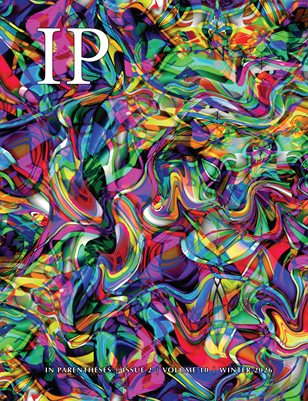
By In Parentheses in Volume 10
44 pages, published 1/15/2026

 in parentheses
enter the discussion: