
Joe Giordano’s stories appeared in The Saturday Evening Post, and Shenandoah, plus his short story collection, Stories and Places I Remember. His novels include Birds of Passage, An Italian Immigrant Coming of Age Story, and the Anthony Provati thriller series: Appointment with ISIL, Drone Strike, and The Art of Revenge. http://joe-giordano.com/
No Justice
I’d grabbed a smoke in the back alley outside Duffy’s Tavern, huddling in the doorway, trying to stay dry amidst a raging thunderstorm. The starless sky rumbled, intermittently shooting orange red through muscular clouds as the rain came down in sheets. I spent the previous hour debating philosophy with my drinking companion Kaz Baker, a fellow student. We’d been more successful getting a snoot full of beer than solving the world’s problems, and I was a little unsteady on my feet. I was about to head back inside for round two with Kaz when the hair on my arms stood up. Suddenly, I was momentarily blinded by a light flash simultaneous with a thunderclap like an atomic detonation. My back slammed against the door almost throwing me to the ground. I gasped, my skin tingling, realizing that I’d been dangerously close to a lightning strike. On trembling legs, I returned to the safety of the bar.
Kaz was standing. “Wow, that was close.”
I must’ve looked as shaken as I felt because Kaz asked, “Paul, are you all right?”
“The damn lightning.”
He pulled a stool. “Take a seat. You look pale.”
“A freak accident could’ve fried me.”
“Hey,” Kaz said, “life’s fragile as well as absurd.”
The bartender came over, looking concerned. “How about a whiskey? On the house.”
I gratefully agreed, chasing the shot with half a mug of beer, then blowing out a long breath, my heart rate finally slowing. I gestured to the bartender for a refill, saying to Kaz, “I’m okay.”
Kaz teased. “Did you hear the voice of God?”
“Only the internal one telling me how lucky I’d been.”
“I thought you might’ve had a Road to Damascus experience, like your namesake.”
“You think St. Paul was knocked off his horse by lightning?”
“A more logical possibility than God accosting him for persecuting Christians. People were superstitious in those days. Maybe he had a guilty conscience, or maybe he just wanted an excuse for not tagging along with his bigoted buddies.”
Kaz’s souring on all things Christian had been triggered by the string of unprosecuted pedophile priests. I wondered if he’d also been the victim of abuse.
“You’ve become quite the blasphemer,” I said.
“God is dead.”
I groaned. “Not existentialism, again.”
“Don’t blame philosophy for the decline in religious belief. In commending its followers to seek the Truth, Christianity sawed off the limb it perched on. Like Courbet said, ‘Show me an angel, and I’ll paint one.’”
“Nobody has seen a Black Hole, yet they exist.”
He waved dismissively. “Christianity was invented as revenge of the disadvantaged against the privileged. Easier for a camel to pass through the eye of a needle, and all that.”
“What if you’re wrong? God won’t be happy when you see Her.”
“I don’t make the declaration with any glee, but adults shouldn’t believe in fairy tales.”
“In your world, life is meaningless.”
“That’s why Camus called suicide the existential choice.”
“Don’t you worry about a society without God? Religion stops people from doing bad things.”
“So, men enacted laws.”
“What if earthly justice is inadequate?”
“The rich determine their own fate and follow values based on self-interest.”
“Cynicism on steroids,” I said.
Kaz shrugged agreement. “Nothing changes.”
“Do you have a solution?” I asked.
“Go for the money, whatever it takes.”
“Machiavelli would’ve been proud of you.”
“What’s your alternative?”
“A life of service. We can’t avoid our responsibility to others.”
Kaz scoffed, then referenced his watch. “Got to go. See you tomorrow in class?”
“Sure.” We bumped fists and Kaz took off while I finished my beer.
When I was ready to get back to the university dorm, the rain had stopped, and I headed for the subway. At the top of the station stairs, three guys accosted me. I hesitated to hand over my wallet, and one of them cracked my head with a tire iron, rendering me unconscious.
I awoke in a hospital bed. Standing over me, a blonde doctor frowned. “You’ve been in a coma.”
I tried to speak but had trouble forming words. I attempted to lift my head but fell back onto the pillow. My left side wasn’t responding. I felt a rising panic.
“Don’t struggle,” she said. “You’ve suffered a severe brain injury.”
My memory of what had happened at the subway station was fuzzy.
She continued. “Sometimes the brain recovers by rerouting function around damaged areas, but you may not see improvement for months or even years.”
My eyes welled.
“I’m sorry,” she said. “We’ll keep you comfortable until you’re released. Social services can arrange for a care giver.”
For days, I stewed. How could I continue in school? Would any woman be interested in saddling themselves with a disabled person? I hated my attackers but cursed myself for not handing my wallet over faster.
When Kaz visited me, I averted my eyes.
He grabbed my hand, tearing up as he spoke. “Paul, everybody is asking about you.”
I puffed out a defeated breath.
“The cops grabbed three guys, but a judge released them without bail.” He grimaced. “If you can’t make a positive identification, they’ll never be tried.”
I covered my face, waving for him to leave.
He hesitated, started to go, then turned in the doorway. “Maybe I was wrong,” he said. “Maybe God exists. He must. Otherwise,” he sighed, “there’s no hope for justice.”
I glared at him. “Why would God do this to me?”
Kaz shrank “A test? Part of a plan?”
“God dispatches thugs to ruin my life?”
“You’re hurt and angry but please, don’t give up.”
The powerlessness of dependency, that I’d been rendered an invalid, churned my gut, and my mind sank into a depression deep as a glacial crevasse. Life was sweet until it wasn’t, and all I wanted was for the pain to end. Resolved but tearful, downing a bottle of opioids, I made the existential choice.
From the Editor:
We hope that readers receive In Parentheses as a medium through which the evolution of human thought can be appreciated, nurtured and precipitated. It will present a dynamo of artistic expression, journalism, informal analysis of our daily world, entertainment of ideas considered lofty and criticism of today’s popular culture. The featured content does not follow any specific ideology except for that of intellectual expansion of the masses.
Founded in late 2011, In Parentheses prides itself upon analysis of the current condition of intelligence in the minds of these young people, and building a hypothesis for one looming question: what comes after Post-Modernism?
The idea for this magazine stems from a simple conversation regarding the aforementioned question, which drew out the need to identify our generation’s place in literary history.
To view the types of work we typically publish, preview or purchase our past issues.
Please join our community on Facebook, Twitter, or Instagram at @inparenth.
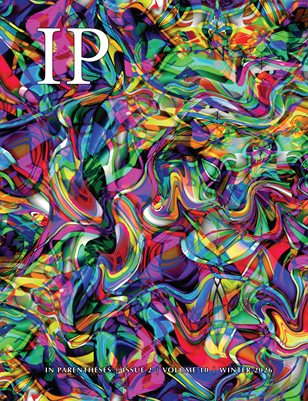
By In Parentheses in Volume 10
44 pages, published 1/15/2026

 in parentheses
enter the discussion: