
Sophia Carter is an undergraduate at the University of Tennessee, her home state. Studying History and Information Sciences, she works as a photographer for Ablaze Magazine and as a young creative writer. In addition to working on her debut novel, she practices poetry, prose, and entertaining her two cats.
Author’s note: ““In the Night the Women Flee” depicts careful relationships between women in a world that mirrors their own creative minds. Despite a society built off of beauty, pain, and everything in between, the relationships they build are often more complicated than these abstract concepts, especially when finding one’s true identity. This poem engages with the female gender in regard to the humanity we find in our own environment, one not so dissimilar from the meadow.”
In the Night the Women Flee
In the night the women flee
There is a silk soft meadow at the bottom of the hill
There is nothing to cry about; they do anyway
They weep tears of honey, of sawdust, of lavender and sage
Where there is joy there is pain, and they wouldn’t have it any other way
In the night the women flee
There are no words to speak so instead they sing
They light fires in the daytime and go swimming at night
They weave blankets for newborns and elders and collect sticks and dirt for fun
They grow up learning to break but then heal,
To lose but then love
There are no mirrors in the meadow because there need not be; their souls are too reliable to need
self satisfaction
But there is a girl by the edge of the pond,
Desperately trying to catch a glimpse of her face
Across the pond her mother throws stones into the water,
Shielding her daughter from ever stealing a look
For years, the girl blames the stones
Then her mother
Then herself
From the Editor:
We hope that readers receive In Parentheses as a medium through which the evolution of human thought can be appreciated, nurtured and precipitated. It will present a dynamo of artistic expression, journalism, informal analysis of our daily world, entertainment of ideas considered lofty and criticism of today’s popular culture. The featured content does not follow any specific ideology except for that of intellectual expansion of the masses.
Founded in late 2011, In Parentheses prides itself upon analysis of the current condition of intelligence in the minds of these young people, and building a hypothesis for one looming question: what comes after Post-Modernism?
The idea for this magazine stems from a simple conversation regarding the aforementioned question, which drew out the need to identify our generation’s place in literary history.
To view the types of work we typically publish, preview or purchase our past issues.
Please join our community on Facebook, Twitter, or Instagram at @inparenth.
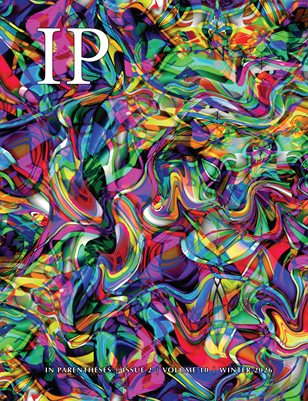
By In Parentheses in Volume 10
44 pages, published 1/15/2026

 in parentheses
enter the discussion: