
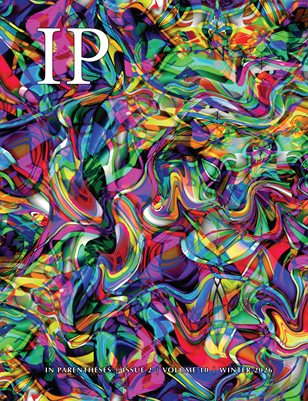
Edward Michael Supranowicz is the grandson of Irish and Russian/Ukrainian immigrants. He grew up on a small farm in Appalachia. He has a grad background in painting and printmaking. Some of his artwork has recently or will soon appear in Fish Food, Streetlight, Another Chicago Magazine, The Door Is A Jar, The Phoenix, and The Harvard Advocate. Edward is also a published poet who has been nominated for the Pushcart Prize multiple times.
E. M. Supranowicz has been previously highlighted by In Parentheses.
Food for Thought
The frogs were laid out on their backs, arms and legs stretched out and pinned to slabs in the dissection pans. A needle had been run through their spines to immobilize them. The high school bio teacher said the frogs did not, would not, feel any pain. She looked a bit like a frog, so maybe she knew what she was talking about.
The teacher instructed the students to make a vertical incision along the center of each frog’s belly to expose the internal organs. She asked them to focus on the beating hearts, then using her favorite expression “food for thought” directed the students to consider how the arrangement of organs might be similar in some ways to the arrangement of organs in humans.
Mark felt his throat and belly tighten at the word “food”, for he had not eaten today or yesterday. His mother had lost her job at the local greasy spoon, and his father was behind on child support payments. He started drifting off, but sat up straight when he heard the instructor ask for a volunteer to clean up the lab after class.
He gathered the frogs up, put them into a plastic bag. The meat was still fresh, and he could already smell the skillet of frog legs his mother would be cooking. He smiled and thought, “Now, that’s what I call food for thought.”
From the Editor:
We hope that readers receive In Parentheses as a medium through which the evolution of human thought can be appreciated, nurtured and precipitated. It will present a dynamo of artistic expression, journalism, informal analysis of our daily world, entertainment of ideas considered lofty and criticism of today’s popular culture. The featured content does not follow any specific ideology except for that of intellectual expansion of the masses.
Founded in late 2011, In Parentheses prides itself upon analysis of the current condition of intelligence in the minds of these young people, and building a hypothesis for one looming question: what comes after Post-Modernism?
The idea for this magazine stems from a simple conversation regarding the aforementioned question, which drew out the need to identify our generation’s place in literary history.
To view the types of work we typically publish, preview or purchase our past issues.
Please join our community on Facebook, Twitter, or Instagram at @inparenth.
By In Parentheses in Volume 10
44 pages, published 1/15/2026

 in parentheses
enter the discussion: