
Ruth Towne is an emerging poet. Other poems from her project Resurrection of the Mannequins have been published by the Decadent Review, New Feathers Anthology, Coffin Bell Journal, and the Stonecoast Review’s Staff Spotlight. Her poem “So the Sadness Could Not Hurt” received. The Orchards Poetry Journal’s second-place Grantchester Award.
@ndrɘ M@ss°n’s Mannequin
What is real?
And who’s to say?
Once, you came back
down Cerise Street,
under lamplight glow,
in the gloaming hour
and autumn’s bronze,
you were a frame of silk stretched,
you were blank mesh under tension.
White gold, the copper red
you said you loved,
then goldenrod again–
when one lamp blinks out,
you will find her,
who you are
whoever you are
a spot of charcoal, a blot of ink–
then, you will have your answers.
Experimental Research
Nocturnal, unfavorable to either love or metamorphosis, the object sits in the palm. Pythagorean, it calls numbers god. It catalogs each day of its life. And it dies if photographed, digitally or on film.
It lives in the open mouth of a nude woman. If she is sleeping, it appears at her throat, where it clutches her neck like a faux-gold choker. And if she were dead? It would rest in the hollow of her pelvis, about twelve inches away from where she’ll lay carefully posed, an exsanguinated figurine, an exquisite corpse.
Once it is dead-dead on a dissecting table, if one plays math rock music, it changes like some cacti, the princess of night blooming in moonlight once each decade, when it displays its obscure and brutal beauty.
*“Experimental Research: On the Irrational Knowledge of the Object: The Crystal Ball of the Seers,” created by Denise Bellon, Gala Dalí, Nusch Eluard, and Yolande Oliviero, appeared in Le Surréalisme ASDLR no. 6 (May 1933).
Exquisite Corpse #04
lobotomize me
reality has a stranglehold
on a life I slept through
where the classic American tragedy
wears Prussian blue on V-J Day
& kisses a sailor in uniform
where any object maker can
draw a line from J@ck the R!ppɘr
through to the Cubists
making one mark for the artist
who painted Camden Town
one for the Mona Lisa’s thief
& one for the death that talked
liked priests with doves
the rest is an intellectual game
a suicide note on plastic magnets
K⊔rt Sɘl!gm@nn’s Mannequin
How beautifully you bruised when your collarbone split,
before calcium carbonate bound to bone. The tissue grew
back scar-hard and carbon-dark. A solitary polyp bloomed,
then one polyp became two. Soon, a secret reef pulsed
between your bones. And you showed me where it hurt.
Once, I was a doll in emerald waters. Don’t you remember?
Now, I adorn myself in drowned women’s jewels and lost
fishing nets. A shoulder blade breaks away, another reef
grows on a statue cast under the sea. You must remember–
you and I are ends of one bone that never healed whole.
The Lovers
Oh, Darling, this is all wrong, I cannot look you in your obsidian eye.
Only bed sheets keep us apart, you and I are lost in soft cotton,
moonstone glow, and pearl white–for all to see, a secret on display.
Now this is as close as you and I can ever get to love,
I never press my skin to yours, or you, yours to mine,
but this is more than you and I will never have, not less.
So, Darling, why do you pull the blank cloth against my face so tight?
From the Editor:
We hope that readers receive In Parentheses as a medium through which the evolution of human thought can be appreciated, nurtured and precipitated. It will present a dynamo of artistic expression, journalism, informal analysis of our daily world, entertainment of ideas considered lofty and criticism of today’s popular culture. The featured content does not follow any specific ideology except for that of intellectual expansion of the masses.
Founded in late 2011, In Parentheses prides itself upon analysis of the current condition of intelligence in the minds of these young people, and building a hypothesis for one looming question: what comes after Post-Modernism?
The idea for this magazine stems from a simple conversation regarding the aforementioned question, which drew out the need to identify our generation’s place in literary history.
To view the types of work we typically publish, preview or purchase our past issues.
Please join our community on Facebook, Twitter, or Instagram at @inparenth.
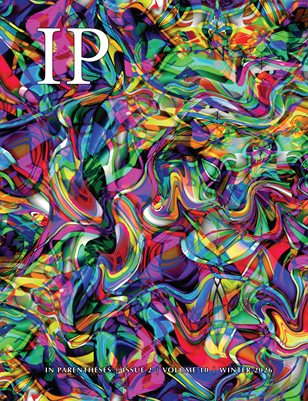
By In Parentheses in Volume 10
44 pages, published 1/15/2026

 in parentheses
enter the discussion: