
Richard Stimac has published a poetry book Bricolage (Spartan Press), over forty poems in Michigan Quarterly Review, Faultline, and december, and others, nearly two-dozen flash fiction in Blue Mountain, Good Life, Typescript, and several scripts. He is a poetry reader for Ariel Publishing and a fiction reader for The Maine Review.
Briseis
The Iliad commenced with a rape,
though you’re sore to miss it. Achilles’ wrath,
blood-purified in a ritual bath,
concealed the violation, as a drape
curtains the naós, or a blue-bruised nape
by a carelessly tossed cloak. Down the path,
into his dark tent, he dragged her. Hell hath
no fury, he warned, if she should escape.
After, Hecuba came, and sat, and spoke,
“None suffered more than me.” She freed a plait
of the girl’s matted hair, then finger-combed
the locks. Briseis’s vacant eyes roamed
the gilt sheets, then she laughed, as if a joke
had been told. She hid her expecting hate.
Cassandra
At recess, the boys pinched her budding breasts.
She cried but didn’t flinch. The mean girls laughed.
The teachers ignored her honest protests.
As if by divine will, a turgid shaft
of sunlight penetrated a cleft cloud.
Just one teacher (the faculty short-staffed)
helped her stand and shooed away a thick crowd
of children abuzz with rumor. The nurse
took note of the bruises. Behind the shroud
of office walls, the principal was terse,
rebuking. Her father threatened to sue.
At last, beaten, all he could was curse
the Church. His daughter learned what was her due:
Her witness would be mistrusted, and true.
Cressida
I’m too weak to visit my mother’s grave.
The neatly set rows of white marble stone
remind me too much of hydra’s teeth sown
in unplowed fields. I pretended to rave,
rent my himation, grovel like a slave,
or a Pythia when, in a low moan,
mumble riddles with answers only known
by God. The women told me to be brave,
to know that in time, the pain and grief
would end, as if a shadow, regret trailed
us, like Furies. Hecuba railed
against men: “It’s what they do. They, they, they . . .
“Vultures. Jackels. What are we, tell me, pray?”
When she died, I felt eternal relief.
Hecuba
Paraded through the streets in chains, she turned
Her eyes backwards, to her burnt home, ransacked,
Walls mosaiced with family myth now blacked
By flame, chairs once set for a king, legs burned,
Toppled tables, where royal courts adjourned,
Her children’s blood plastered across the cracked
Temple marble floors. The queen, bitter, bent-backed,
Looked to the sea, and spoke what she had learned.
No one listened. One guard yawned while the second
Daydreamt of his wife at home. They were young.
The deposed queen’s eyes were grey, like the skies.
This woman would go, Agamemon reckoned,
To Odysseus. With snarl, lolling tongue,
She felt the bitch, deep inside of her, rise.
Priam
“What of it? Priam dies. All fathers die.
“As do all good sons.” She traced the outline
Of his face, the full lips, the aquiline
Nose, heavy brows that framed each almond eye.
She marked the dead body. “We must comply
“With heaven’s mandate. This ravished rough shrine
“Betwixt my legs, where this king drank his wine,
“And reveled . . . my God, is no longer mine.
“An apostate will lie in this royal hall
“And spill his seed upon the sacred stage.”
Now she caressed her own face, the swart mien.
She gouged her fingernails, as if to scrawl
Prophecy on her cheeks: “Here died a queen.”
Her dry breasts would nurse her hate and her rage.
From the Editor:
We hope that readers receive In Parentheses as a medium through which the evolution of human thought can be appreciated, nurtured and precipitated. It will present a dynamo of artistic expression, journalism, informal analysis of our daily world, entertainment of ideas considered lofty and criticism of today’s popular culture. The featured content does not follow any specific ideology except for that of intellectual expansion of the masses.
Founded in late 2011, In Parentheses prides itself upon analysis of the current condition of intelligence in the minds of these young people, and building a hypothesis for one looming question: what comes after Post-Modernism?
The idea for this magazine stems from a simple conversation regarding the aforementioned question, which drew out the need to identify our generation’s place in literary history.
To view the types of work we typically publish, preview or purchase our past issues.
Please join our community on Facebook, Twitter, or Instagram at @inparenth.
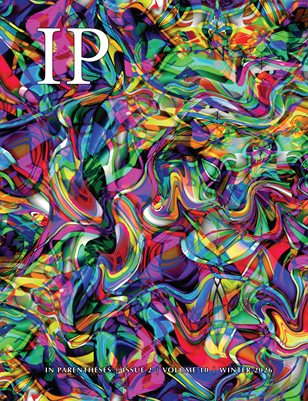
By In Parentheses in Volume 10
44 pages, published 1/15/2026

 in parentheses
enter the discussion: