
William Heath has published three poetry books: The Walking Man, Steel Valley Elegy, and Going Places (Alms for Oblivion is due in the fall); two chapbooks: Night Moves in Ohio and Leaving Seville (Inventing the Americas is due in the fall); three novels: The Children Bob Moses Led (winner of the Hackney Award), Devil Dancer, and Blacksnake’s Path; a work of history, William Wells and the Struggle for the Old Northwest (winner of two Spur Awards and the Oliver Hazard Perry Award); and a collection of interviews, Conversations with Robert Stone. He lives in Annapolis. www.williamheathbooks.com
W. Heath has been previous featured in In Parentheses.
The Myth of Flight
for Hugh Kenner
The classical assumption is
sons should obey fathers,
but had he not built the device
to satisfy the queen’s lust
and the labyrinth to contain her
monstrous get, what need
to invent the wings of wax
tempting the boy to soar
too high, lose his feathers
to the relentless sun, fall
to a watery death?
The strange marriage on
a sand flat of a box kite
and a bicycle, the damn
contraption achieving flight,
what happened at Kitty Hawk
is in all the books, but what
the Wright boys did is as much
part myth as what a designing
father once made to free
his son from the amazed
Minotaur’s dominion.
Artists: Then & Now
Are those broken pots
archeologists find in middens
due to slippery fingers,
floors of stone, or perhaps
some finicky pot-thrower
seeking perfection
in a cup, a bowl, a plate,
smashes in frustration
askew efforts that fail
to meet her standards,
achieve a work of art,
just as a writer, in the days
of typewriters, pulls out
a botched sheet, crumples it,
and sends it sailing toward
a circular file overflowing
in a far corner of the room.
Fire
If someone cries fire
in a crowded theater
suddenly we realize how
confined the seating is,
one person at a time can
exit a row, two at most
through a door, no wonder
this causes a pandemonium
of screaming people ruthlessly
competing with each other
to save their own skins.
A panicked mob behaves
like those around them
were fire too. Some are
trampled as if to stamp out
the blaze. Try to tell those
who died self-restrait
might have saved them
Fire is insatiable, everything,
however diverse, goes up
in the same flames, leaves
the same black scar. We
ask who started the blaze,
but the fire doesn’t care.
Ubiquitous, it can appear
at any time and any place,
consuming all in its path.
Man once fled from fire,
then he learned to hold
a firebrand without fear.
A small matchbox contains
the power to destroy
an entire forest, one splinter
tipped with phosphorous
can start a conflagration.
Bats
Birds hunt bugs by day,
bats work the night shift.
Their sonar system keeps
them from colliding with
stalactites in a dark cave.
The echoes of their calls
tell them how to navigate
the night air. This same
system helps them locate
and eat various insects.
When bats cry out we
do not hear them, their
high-decibel shrieks
sound like silence.
Losing It
If a squid loses the tip
of an arm to a rival squid
it knows it’s been hurt,
its whole body reacts,
becomes hypersensitive,
but it doesn’t know
which arm suffered
the painful loss.
If a squid loses part of an arm
to a rival or a crab’s pinchers,
it jets away squirting black ink.
The squid never touches
the severed spot, rather it acts
as if its whole body
was one big sore.
Unlike a squid,
an octopus knows if
one of its arms
has lost a tip, or been
otherwise injured.
It will cradle
the wounded limb
to protect it from
further harm.
From the Editor:
We hope that readers receive In Parentheses as a medium through which the evolution of human thought can be appreciated, nurtured and precipitated. It will present a dynamo of artistic expression, journalism, informal analysis of our daily world, entertainment of ideas considered lofty and criticism of today’s popular culture. The featured content does not follow any specific ideology except for that of intellectual expansion of the masses.
Founded in late 2011, In Parentheses prides itself upon analysis of the current condition of intelligence in the minds of these young people, and building a hypothesis for one looming question: what comes after Post-Modernism?
The idea for this magazine stems from a simple conversation regarding the aforementioned question, which drew out the need to identify our generation’s place in literary history.
To view the types of work we typically publish, preview or purchase our past issues.
Please join our community on Facebook, Twitter, or Instagram at @inparenth.
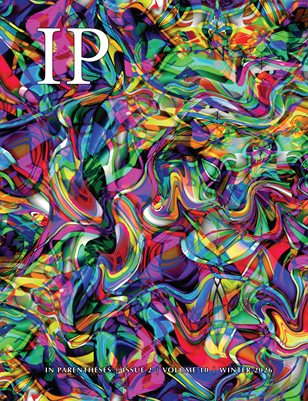
By In Parentheses in Volume 10
44 pages, published 1/15/2026

 in parentheses
enter the discussion: