Marisa Mangani’s memoir, Mise en Place: Memoir of a Girl Chef, won the 2023 gold medal for Women’s Biographies by the Global Book Awards, and the 2023 gold for Memoir and Biography by Royal Palm Book Awards. Her essays and fiction have been published in Hippocampus, Literally Stories and others.
Aloha Spirit
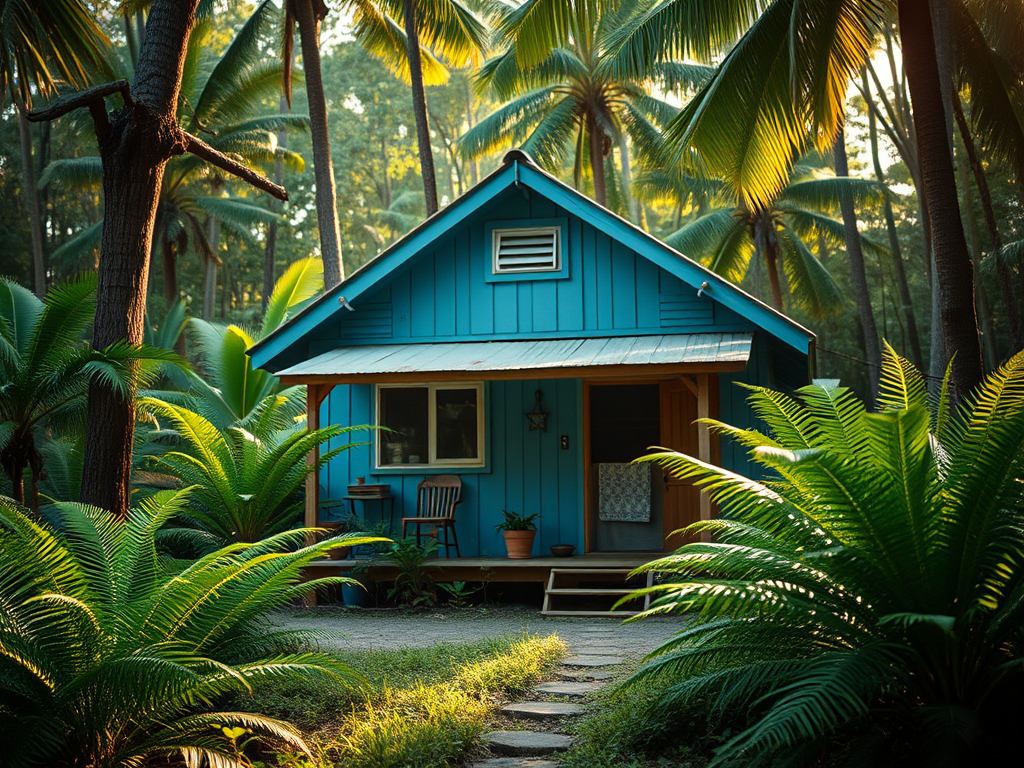
Lydia climbed into her rental car and drove out of the Hilo Airport toward the volcano, heading to Fern Forest to see what she had done with most of her life savings of sixteen thousand dollars. Cash. Sight unseen except for the pictures on Zillow of a blue cabin, bordering on “shack.” Her near animal drive to get away from her hum-drum life in Portland and to start over on the Big Island had convinced her that to live in a cabin-shack in the woods, with no water or electricity as she knew it, would be her balm.
According to Zillow, solar panels, photo-voltaic batteries, and a water catchment system could be updated for her life off-the-grid. She knew nothing about any of these things.
According to the internet, Fern Forest is a place “where people go to disappear,” which was fine with Lydia, she wanted to, in a sense, disappear, but what did that mean exactly? Witness protection people? Felons on the run? Weirdos and creeps?
She hoped the Aloha Spirit was not a myth and that she’d find friends.
Lydia passed through Kurtistown, noted a gas station or two, and continued west on Highway 11. The sun-dappled growth edging the two-lane gave way to velvety ferns, and she felt the air through her open window cool as the elevation climbed.
Lydia had never done anything like this before, and her stomach reminded her of this. In a year she’d retire from nursing, and she’d been determined to not look back and feel as though she’d been working her entire life just to pay bills. Oh sure, she’d helped many people, there was reward in that, but what was left of her future? She had loved nursing, but why stay on, like so many of her peers, in a city clogged with traffic, and waiting for free time to do something fun? Here in Paradise, she’d be doing something fun every day. After she figured out how to get water, power, and Netflix.
The potholed road went on and on, everything non-descript, except for a few gravel cross-streets posted with Hawaiian names. Solitary electric poles rose up choked with vines. Finally, a small general store appeared, advertising Kona beer, which gave some relief that, at least there was beer nearby. Then she saw a small restaurant in a red, one-room cottage surrounded by banana trees. A place to hang out without diving thirty-five minutes to Hilo! Not as remote as it looks, she thought. And the wild tree ferns growing at the side of the road were lovely.
Hippie communes came to mind. Pot farms. Composting. All of this, fine with her. Lydia wondered if she, a spinster nurse, would fit in, then laughed at herself for feeling like a teen. Naw, she supposed, she was old enough now to do anything, anywhere. She’d seen on her Google map something called Yoga Yurt. Maybe she would take up yoga.
She had drawn herself a map, in case cell service got spotty, which it did, and she followed it until she got to the un-named dirt road that would lead to her Shangri-la. Her heart leaped in her chest as she turned into a tunnel of ferns, and she reminded herself that she had a year to get the place livable. She expected there would be rotten drywall, overgrowth, corroded batteries, destroyed pipes, broken windows. For sixteen thousand dollars, what did one expect? She’d planned for this, she could do some of the work herself, hire workers from Hilo, and wait for Hawaiian time to accommodate her.
The rental car bumped up the steep road. When she got to a small clearing she saw a scene that had not been revealed in the Zillow pictures. Her heart caught in her throat and tears rushed up. “Oh no!’ she exclaimed. She parked on the flattest part of knee-high grass and trudged around as best she could. How much would this cost? What a mistake she’d made! The sun burned down upon her white arms as if judging her. Her mind conjured up a crime scene and blood spatter, she didn’t know why. She got back in the car, drove away from her silly dream, and parked at the red-cottage restaurant. Took a deep breath and went inside. Would they laugh at her?
The screen door banged behind her and a pretty local girl greeted her at the counter. “Howzit? We have pizza today.”
Lydia looked at the grease-board menu. “Um, yeah, can I have a slice?” Then her damp eyes filled up again and she turned away.
“Oh! Lady, what’s wrong, eh?”
Lydia turned back and wiped at her eyes with plump fingers. “Um, so, I just bought the property up the hill? The one with no street name, the blue shack?”
“Ah yeah. The old Dexter place, yeah,” she said solemnly. “Hold on.” She disappeared through a door behind the counter and returned with a gray-bearded man.
“You wen bought da Dexter place?” The man asked, without the laughter she had expected.
Lydia nodded.
“Dey still got that giant bus in da ground?
She nodded again. “It’s blocking the door, I can’t even get inside to see — how’d they even get it up there? Do I have it air-lifted out or something?” Costing the rest of her savings.
The man smiled. “Eh, no. If you had that kind of money you coulda bought some-ting nicer than de old Dexta place, yeah?”
Lydia nodded, defeated.
“You gotta cut it outa dere. Into pieces, den haul ’em out.”
“But how—who—”
“Ah, lady, pleny people ’round here need da money, eh?” He turned to the girl, who had just put a slice of pizza on a paper plate. “Niki, go call up Kimo, see wen Mike get his tools, eh?”
“Yeah, Poppa.”
Lydia took the pizza slice from the girl, stared out at the banana trees swaying in the soft wind, and thought, she could do this.
Aloha.
From the Editor:
We hope that readers receive In Parentheses as a medium through which the evolution of human thought can be appreciated, nurtured and precipitated. It will present a dynamo of artistic expression, journalism, informal analysis of our daily world, entertainment of ideas considered lofty and criticism of today’s popular culture. The featured content does not follow any specific ideology except for that of intellectual expansion of the masses.
Founded in late 2011, In Parentheses prides itself upon analysis of the current condition of intelligence in the minds of these young people, and building a hypothesis for one looming question: what comes after Post-Modernism?
The idea for this magazine stems from a simple conversation regarding the aforementioned question, which drew out the need to identify our generation’s place in literary history.
To view the types of work we typically publish, preview or purchase our past issues.
Please join our community on Facebook, Twitter, or Instagram at @inparenth.
By In Parentheses in Volume 10
44 pages, published 1/15/2026

 in parentheses
enter the discussion: